> ## Documentation Index
> Fetch the complete documentation index at: https://docs.snagsolutions.io/llms.txt
> Use this file to discover all available pages before exploring further.
# Merge a GitHub PR
> GitHub PR merge loyalty rule. Reward users for getting pull requests merged into your repository.
## **Overview**
This loyalty rule allows admins to reward users for merging pull requests to a specific branch in a [GitHub](https://github.com/) repository. This rule is useful for incentivizing contributions to your open-source projects and rewarding active developers who merge PRs to your codebase.
## **Prerequisites**
* The user must have connected their GitHub account to Snag.
* The user must have merged at least one pull request to the specified branch in the target repository.
* The user's GitHub access token must be valid and have appropriate permissions to access the repository.
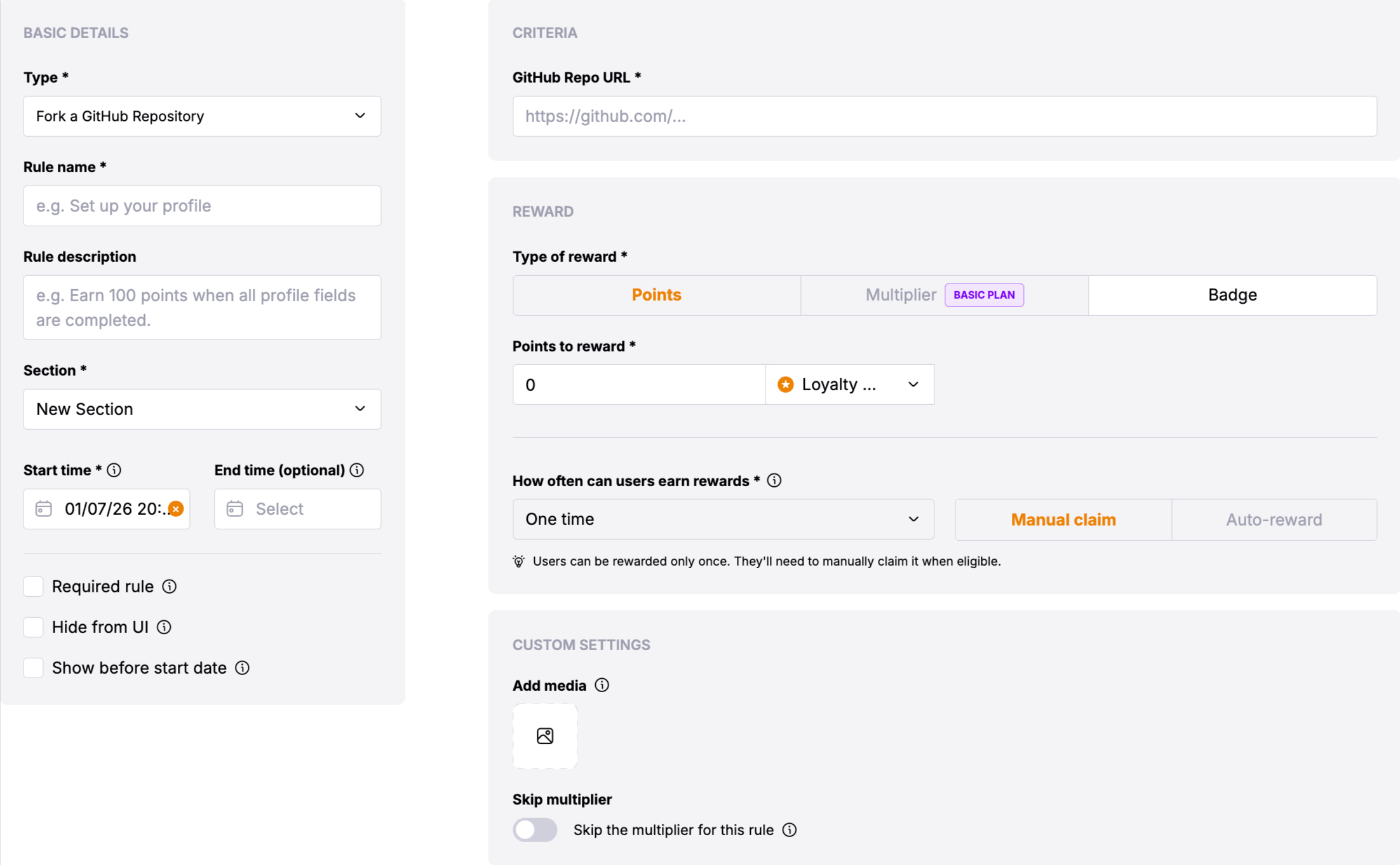
## **Rule Configuration Fields**
### **Reward**
* **Type of Reward**: Choose between "Points" or "Multiplier".
* **Points**: Users will receive the defined number of points based on their activity or achievement.
* **Multiplier**: Users will receive the multiplier of the defined range based on their qualification level.
* **Required Range**: Define a numerical range for eligibility (tokens, actions, followers, messages count, etc.).
* **Points to Reward**: Define the number of points assigned for the specified qualification range.
* **Add New Range**: Allows defining multiple qualification ranges with corresponding rewards.
### **Basic Settings**
* **Update Cadence**: The Merge GitHub PR rule can be configured to run on a **daily**, **weekly**, or **monthly** interval. The system will check for merged PRs during each interval period.
* **User Reward Frequency**: Users can claim rewards **once**, **daily**, **weekly**, or **monthly** based on the configured frequency. The system tracks merged PRs within the specified time window.
**Time Window Restriction**: Only PRs merged within the **last interval
period** are counted toward rewards. For example: - **Daily rule**: Only PRs
merged from the last day to today will be counted - **Weekly rule**: Only PRs
merged from the last week to today will be counted - **Monthly rule**: Only
PRs merged from the last month to today will be counted PRs merged outside of
this time window will not be included in the reward calculation.
### **Custom Settings**
* **Skip the multiplier for this rule**: Toggle to skip the multiplier for this rule
* **GitHub Repo URL** \*: The full URL of the GitHub repository where users need to merge PRs (e.g., `https://github.com/owner/repository`). This is a required field that identifies the target repository.
* **GitHub Branch Name**: The name of the branch where PRs must be merged (e.g., `main`, `develop`, `master`). If not specified, the system defaults to `main`. Only PRs merged to this specific branch will be counted.
## **Verification Process**
Users verify their GitHub PR merges through the following process:
Users must first connect their GitHub account to Snag if they haven't already done so. The system requires a valid GitHub OAuth access token to verify PR merges.
Users create and merge a pull request to the specified branch in the target
GitHub repository. The PR must be merged (not just opened or closed) to count
toward the reward.
After merging PRs, users can claim the reward through the loyalty rule
interface. The system will verify the number of merged PRs within the
configured time window.
The system verifies that: - The user's GitHub account has access to the
repository - The user has merged PRs to the specified branch - The PRs were
merged within the configured time window (based on the rule's interval) - The
repository URL and branch name match the configured values - The merged PRs
were authored by the user's connected GitHub account
The system counts the total number of merged PRs within the time window and
calculates rewards based on the configured range tiers. If range-based rewards
are configured, users receive rewards corresponding to the number of PRs
they've merged.
Once verified, users receive their reward based on the number of merged PRs and the configured reward ranges.
## **How It Works**
The rule uses the GitHub Search API to count merged pull requests. The system:
1. **Queries GitHub API**: Searches for merged PRs using the GitHub Search API with filters for:
* Repository owner and name
* Branch name (base branch)
* Author (the user's GitHub username)
* Merge date (within the last interval period - e.g., last 24 hours for daily rules, last 7 days for weekly rules, last 30 days for monthly rules)
* PR status (merged only)
2. **Counts Merged PRs**: Returns the total count of merged PRs matching the criteria.
3. **Calculates Rewards**: If range-based rewards are configured, the system matches the PR count to the appropriate reward tier and distributes the corresponding reward.
4. **Handles Token Refresh**: The system automatically refreshes expired GitHub access tokens when needed to ensure continuous verification.
## **Important Notes**
The GitHub Repo URL should be in the format
`https://github.com/owner/repository`. The system will automatically parse the
owner and repository name from the URL.
The GitHub Branch Name is optional and defaults to `main` if not specified.
Only PRs merged to the specified branch will be counted. Make sure the branch
name matches exactly (case-sensitive).
The system only counts PRs that have been **merged** (not just opened or
closed). Draft PRs or PRs that were closed without merging will not be
counted.
The rule supports range-based rewards, allowing you to reward users with
different amounts based on the number of PRs they've merged. For example, you
can reward 10 points for 1-2 PRs, 25 points for 3-5 PRs, and 50 points for 6+
PRs.
**Interval-Based Counting**: The system only counts PRs merged within the
current interval period. When the rule runs: - For **daily** rules: Only PRs
merged in the last 24 hours (from the last run to now) are counted - For
**weekly** rules: Only PRs merged in the last 7 days (from the last run to
now) are counted - For **monthly** rules: Only PRs merged in the last 30 days
(from the last run to now) are counted This ensures that users are rewarded
for recent contributions within each interval, not for all-time PR counts.
## **Example Use Cases**
* **Open Source Projects**: Reward contributors who merge PRs to your main branch
* **Development Teams**: Incentivize team members to merge PRs to specific feature branches
* **Community Engagement**: Encourage community contributions by rewarding merged PRs on a weekly or monthly basis
* **Quality Contributions**: Use range-based rewards to incentivize multiple contributions (e.g., more PRs = higher rewards)